Showing posts with label Toyota way. Show all posts

Thursday, 17 April 2014

Toyota Way (Final part)

TPS tools help us in achieving Toyota way. The below two principles help us in understanding the TPS tools more effectively and most commonly used terms hereafter.

Kaizen:
Kai- Change
Zen- Good
So Kaizen means change for good. Any improvement (small or big) done to eliminate waste is called Kaizen.
 Kaizen has to be done to reduce the gap either in occurrence type or setting type. This change for good should happen continuously and so the term ‘Continuous improvement’.
Kaizen is not innovation; the following table from one of the earlier Japanese text books (1986) helps me in validating my statement.
  
Reducing any of the listed below 7 types of Muda (Waste) is called kaizen.
  
As mentioned earlier, Overproduction is the biggest muda and it leads to all other muda’s (as you read in the example of Curious case of vegetable seller) and so it should be attacked first.
 Muda is present in all the processes. Any process will have only 20 to 30% processing time and 70 to 80% non processing time. We must develop critical eye in order to eliminate muda from the non processing time. Of course there will be some muda in the processing time too, but the scope is less if the process is designed as per standard work.
   This also reminds me of the famous quote by Robert Bosch.
 “There is nothing that cannot be improved further”
Genchi Genbutsu:


This is always associated with 3G:
1)    Gemba: Actual place.
2)    Genbutsu: Actual thing.
3)    Genjitsu: Actual situation.
 Imagine Sherlock Holmes sitting at his desk and solving crimes. Funny isn’t it?
Same applies to the Engineers or Managers who sit in office and try to analyze causes for the problems in the shop floor. 
Genchi Genbutsu means ‘Go and See’ at the actual place (Gemba) to truly understand the actual thing in the actual situation.
 Taiichi Ohno used to draw circles in the shop floor and asked Engineers to stand inside the circle and observe the process for improvement which is now widely known as ‘Ohno circles’. 

 ‘Seeing is believing’ approach helps in identifying the exact root cause for the problem as well as to identify the waste in the process. The longer we observe the process, more the number of problems that comes to the surface. No problem is the biggest problem!
 These are the steps that can be followed here:
1.    When a problem arises, go to the actual place; observe the actual thing at the actual 
      time (Situation).
2.    Identify the problem.
3.    Take temporary or counter measure on the spot.
4.    Find the root cause and take a permanent measure.
5.    Standardize the solution to prevent recurrence of the problem.
 A request to managers and supervisors is to ensure at least they spend quarter of their time in the actual work place. This will keep more than half of their troubles away.

Management by walking around in HP:
          In the early days of Hewlett-Packard (H-P), Dave Packard and Bill Hewlett devised an active management style that they called Management by Walking around (MBWA). Senior H-P managers were seldom at their desks. They spent most of their days visiting employees, customers, and suppliers. This direct contact with key people provided them with a solid grounding from which viable strategies could be crafted.
         Going to the source is not limited to only production but to any field of work. Once we start observing the process, we must build a habit of questioning ourselves again and again. Preferably Why Why Why? Till we get a solution/root cause to our problem. These problems are golden eggs. Why’s are not limited to just 5 times. That’s a myth. Sometimes we might get the solution at 2nd time or 20th time of asking ‘why’. 5 why is the name of a technique and not limited to just 5 why’s! It’s a thumb rule to ask why a minimum of 5 times to go to the root of the problem.
Most of the times, this analysis leads to the Method we are following and need to improve that.
Let’s take a simple example to understand this theory.
Bulb is not switching on
Why?
There is no power supply to the bulb.
Why?
The fuse is not working.
Why?
There is no power supply to the fuse.
Why?
There is no power supply in the wire.
Why?
The socket is damaged.
Why?
The plug was not put correctly.
So the root cause here is plug was not put correctly and hence the socket was damaged. The socket should be replaced and care must be taken while inserting the plug.

As you can observe in this analysis, instead of replacing the socket, if the bulb or fuse was replaced, then the problem would have not been solved. Taking a wrong countermeasure is not only a waste of time and money but also might cause more problems.

Another key point to remember here is the verification of the 5 why. 5 why can be verified if it satisfies the therefore condition. Let’s verify my root cause.
The plug was not put correctly therefore the socket was damaged, therefore there was no power supply in the wire, therefore there was no power supply to the fuse, therefore the fuse was not working, therefore there is no power supply to the bulb, therefore the bulb is not switching on.
If it doesn’t satisfy this condition, then there is a mistake in the analysis.

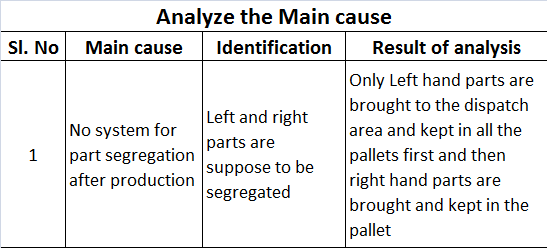
I will give one of the 5 why analysis done by me to eliminate wrong part supply to customer.


Please do the therefore analysis and give feedback to me .
This completes the Toyota way module.


Monday, 31 March 2014

Toyota way (Part 1)

There are many journals, books and websites to explain Toyota way in broader approach and they provide extensive examples but my objective is to help beginners understand this concept in a simpler and concise way.

I will explain this concept in 3 parts for better understanding.

Generally 14 principles are associated with Toyota way. I really don’t understand why all of them are given in Toyota way (Maybe because there is no TPS way). There are 5 operating principles and other principles are explained in the house of TPS (which will be our next topic). Toyota way is like the heart and TPS is the brain, as I mentioned in my first post. TPS are the tools employed to maintain the integrity of Toyota way and driving force for improvements. I will discuss about these 5 operating principles now. This is the systematic way to go about it. Let's follow the step by step approach.


Maybe this house didn't make much sense in the first post. Let's crack the case now.


Respect for people involves two principles:

Respect and Team work:

Man forms an important factor to any organization. A leader who can effectively control man (which is the only resource that can think) can run an organization efficiently. No two persons think completely alike. Appreciating the common things and respecting the differences keeps the relationship going. One person alone cannot achieve much but a group of people collectively can achieve a lot.

 One of my ex company head always said this “I don't want one person taking 100 steps but 100 people taking one step”. An organization can never grow no matter how much an individual contributes, if a group of people collectively contribute even a little, the results can be amazing!!
I would like to share my own experience in this regard.

After my TPS training, I was asked to take up a theme activity (Jishuken) at one of our vendors and do quality improvement. I was excited about this as I was the leader of the activity. We formed the team and the team comprised of inter-disciplinary departments. Following are the steps of any theme based activity.
1.      Select theme
2.      Grasp present condition and identify weak areas
3.      Set target
4.      Analyze the causes and implement countermeasures
5.      Check results
6.      standardize the solution
7.      Reflect on the process


I don’t want to go in depth into these steps as theme based activity is considered to be the last step of TPS. This is just for your understanding and I will explain these activities in case studies separately in the future. I will continue with my story.

As the activity leader, I gave individual tasks to the members and asked them to close the issues. I didn't want to explain the whole activity to each of them as I wanted only me to get all the credits (I learned this mistake very soon, few people don't understand this, I pity them). They completed the activity assigned to them but when we reached the step 5, we hadn't made any progress. I was bewildered.


Root cause:
They made every possible effort to ensure that their individual process doesn't produce any defect. When a holistic analysis was made, defects were made in the previous process or in the subsequent process which they had obviously overlooked as they were busy improving their own process. These sorts of activities are prevalent even to this day. Results cannot be achieved by individual contribution alone. Everything is interdependent in an organization and team work is the only way to make a progress. Now read respect and team work in the above house and analyze the problem by your self.

Individual growth doesn't ensure company's growth always and in the long term an individual will definitely fail trying this approach but working in a team towards the company's growth will definitely ensure individual's growth in the long term.


Team work works!!